01 / Executive brief
Executive summary
For roughly eleven months, Google engineer Linwei Ding moved more than 2,000 pages describing the infrastructure behind Google's large AI systems into personal cloud storage. He copied source material into a text application, converted it to PDFs, and uploaded it while concealing executive and founder roles with AI ventures in China. S1S2
A jury found that Ding stole seven categories of trade secrets covering TPU and GPU systems, cluster software, networking, and SmartNIC components. The current legal boundary is important: all seven theft convictions remain, but on August 20, 2026 the judge set aside the economic-espionage verdicts because government benefit was not proved beyond a reasonable doubt. The surviving record establishes theft for Ding and a China-based venture, not a PRC state nexus. S1S2S3
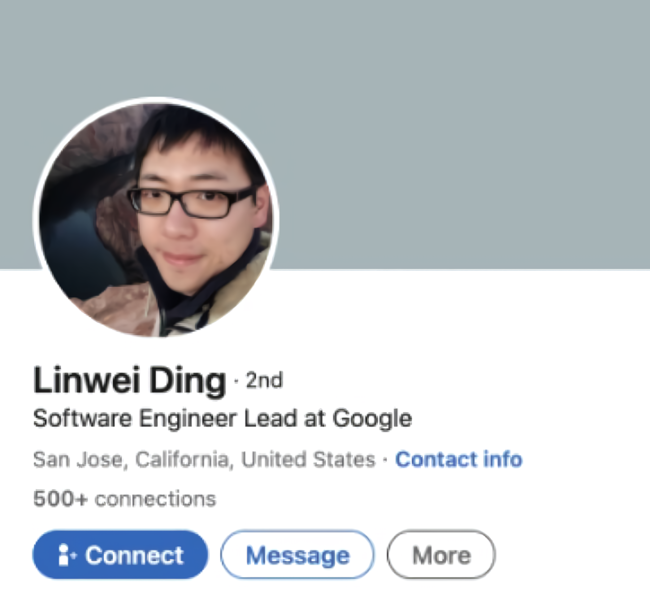
Linwei Ding in a screenshot of his since-removed LinkedIn profile, reproduced by Xataka México. The profile identified him as a software engineer and lead at Google; it predates the criminal case.
LinkedIn profile screenshot, via Xataka México · Editorial use; all rights remain with the source
Large AI systems depend on tightly integrated compute, storage, and networking infrastructure. Ding's surviving convictions concern confidential designs spanning that stack. Contextual image; not Google equipment from the case.
Federal Bureau of Investigation · Public domain02 / The vignette
What happened
The target was the system behind the model
Ding's access reached beneath AI applications to the infrastructure required to train and operate them at scale: custom accelerator systems, GPU systems, cluster-management software, high-performance networking, and SmartNIC technology. Those components describe how thousands of processors can be made to function as one dependable AI supercomputer. S1S2
Copying and outside business advanced together
Between May 2022 and April 2023, Ding converted confidential source files into PDFs and uploaded them to a personal account. At the same time, he pursued a chief-technology role and founded his own AI company in China without disclosing those activities to Google. Trial evidence included representations that the venture could build a company 'like Google' and copy and modify Google's technology. S1S2
Theft survived; espionage did not
The jury returned fourteen guilty verdicts in January 2026. Post-trial review divided them: the court preserved seven trade-secret-theft convictions, then acquitted Ding on seven economic-espionage counts after finding the Chinese-government-benefit element legally insufficient. Sentencing on the surviving counts was still pending at this dossier's review date, so the file treats the theft as adjudicated and the alleged state nexus as unproved. S1S2S3
03 / Anatomy
How access became transfer
This chain reconstructs the sequence supported by the cited record. It does not imply that every legitimate relationship follows the same path.
- 01
- 02
Sensitive access gained
Seven technical domains
The protected material covered TPU and GPU systems, cluster-management software, networking, and SmartNIC components. S1
- 03
Information acquired
Uploads disguised
Ding copied source files into a text application, converted them to PDFs, and uploaded more than 2,000 pages to a personal cloud account. S1
- 04
- 05
- 06
04 / Evidence boundary
What is established—and what is not
Established in the record
- The surviving jury verdicts establish that Ding stole seven categories of Google AI trade secrets to benefit himself and a China-based company. S2S3
- The copying occurred alongside undisclosed outside business activity and was used to support a venture claiming Google-like AI infrastructure capabilities. S1S2
- A federal judge expressly rejected the claim that the evidence proved the required Chinese-government benefit beyond a reasonable doubt. S3
Uncertain, limited, or unresolved
- Sentencing and any appeal had not occurred by the August 23 review date; the case requires a prompt procedural refresh after September 1. S3
- The original Justice Department release described all fourteen jury verdicts, but the later court ruling controls this file's current status and eliminates the economic-espionage findings. S1S3
05 / Sequence
Timeline
-
Outside roles concealed
He pursued executive and founder roles in China while remaining a Google employee. S1
-
Jury verdict
The jury returned guilty verdicts on seven theft and seven economic-espionage counts. S1
-
Theft verdict challenges rejected
The court rejected Ding's post-trial challenges other than the government-benefit question reserved for a separate opinion. S2
-
Espionage counts set aside
The court acquitted Ding on the seven economic-espionage counts while leaving all seven trade-secret-theft convictions standing. S3
06 / People and institutions
Who appears in the public record
Linwei Ding
Former Google software engineer and founder of Zhisuan Technology
Outcome: Convicted on seven trade-secret counts; acquitted post-trial on seven economic-espionage counts; awaiting sentencing at review
Zhisuan Technology
China-based AI venture Ding was forming while uploading Google material
Rongshu
China-based technology company that hired Ding as chief technology officer while he remained at Google
Originator / affected institution
Google LLC
Developer and owner of the protected AI-supercomputing architecture and operations information
07 / Consequences
Documented and attributed harm
The theft exposed design and operating details across seven categories of Google's AI-supercomputing stack to a founder building a competing capability. S1S2
No monetary loss or sentence is assigned here because the surviving convictions had not yet reached sentencing at the review date. S3
08 / Hindsight analysis
Where leadership could have seen risk
These are our analytic judgments based on the public record, not court findings. They are framed to improve controls without treating nationality as a risk factor.
Cloud-native theft looked like ordinary work
Reformatting and uploading documents through familiar applications can evade controls aimed only at removable media or raw source-file transfers.
Outside leadership remained undisclosed
A sensitive engineer could pursue executive and founder roles overlapping his employer's technology. Conflict review and access governance were not joined quickly enough.
State nexus was overclaimed
The post-trial ruling shows why institutional risk teams must distinguish a China-based competitor and talent-plan activity from proof of government direction or benefit.
09 / Apply the lesson
Actions leaders can take
- companies
Detect content transformation
Monitor unusual print-to-PDF, copy-paste, mass document rendering, and personal-cloud upload patterns around crown-jewel repositories, with privacy and employment-law review.
- both
Join conflicts to access
Require disclosure of overlapping founder, executive, advisory, and fundraising roles and route relevant conflicts to a documented least-privilege access review.
- companies
Separate conduct from attribution
Investigate copying and conflicts based on logs and behavior; assign government nexus only when evidence supports it, and keep that conclusion independently reviewable.
10 / Source record
Sources
Links point to the public record reviewed for this file. Government releases can summarize court proceedings but remain government-authored sources; the source note identifies those limits.
- S1 government release
Former Google Engineer Found Guilty of Economic Espionage and Theft of Confidential AI Technology ↗
U.S. Department of Justice · Published Jan 30, 2026 · Retrieved Aug 23, 2026
Jury-verdict and trial-evidence summary; the later partial acquittal supersedes its description of the economic-espionage outcome.
- S2 court record
United States v. Ding, Order on Motion for Judgment of Acquittal or New Trial ↗
U.S. District Court for the Northern District of California via GovInfo · Published Jun 29, 2026 · Retrieved Aug 23, 2026
Court order sustaining the theft verdicts and reserving the government-benefit question for a later opinion.
- S3 reputable reporting
Ex-Google Engineer's Conviction for Stealing AI Secrets Partially Overturned ↗
Reuters via StreetInsider · Published Aug 20, 2026 · Retrieved Aug 23, 2026
Current report on the August 20 acquittal of the economic-espionage counts, the surviving theft convictions, and pending sentencing.