01 / Executive brief
Executive summary
Xiaoqing Zheng worked at GE Power from 2008 to 2018 on turbine sealing technology. In 2018, investigators alleged that he encrypted proprietary files, embedded them within the binary code of a digital sunset photograph, and emailed the disguised package from his GE account to a personal address—a concealment method he admitted having used on fewer than ten earlier occasions. S1S2S3
A federal jury convicted Zheng of conspiracy to commit economic espionage, finding a plan to benefit the PRC, foreign instrumentalities, and China-based companies. The jury acquitted him on four additional counts and deadlocked on seven, and the court later imposed 24 months in prison, a $7,500 fine, and one year of supervised release. S2S3
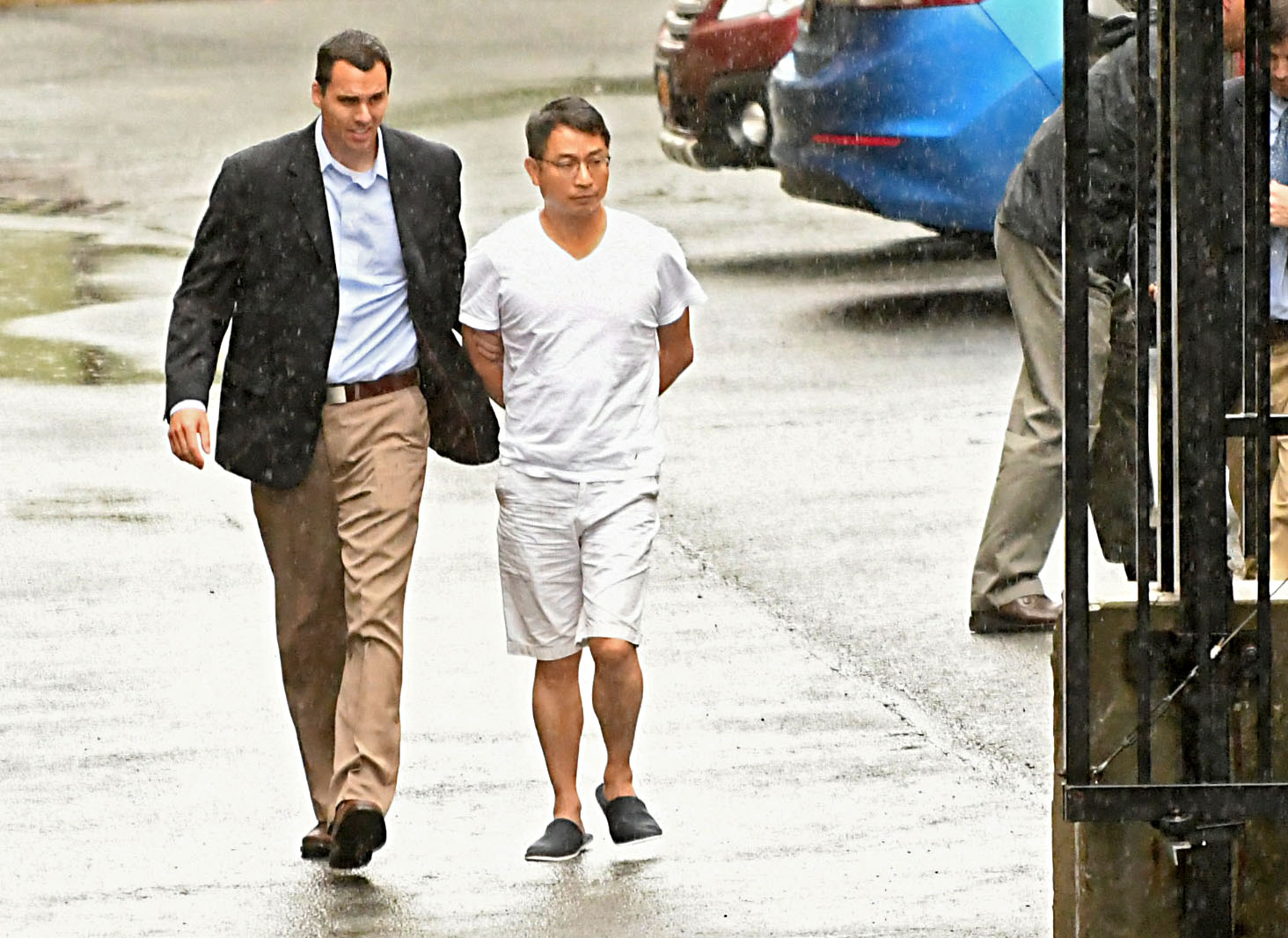
Xiaoqing Zheng outside federal court in Albany in 2018. The image documents the actual defendant; it is not evidence of the charged conduct.
Lori Van Buren / Times Union · Editorial use; all rights remain with the photographer and publisher02 / The vignette
What happened
Engineering access met outside business interests
Zheng's GE role placed him inside a specialized turbine program, while his outside relationships connected that expertise to businesses and institutions in China. The indictment described companies he and relatives established to develop turbine parts and links to PRC talent programs and universities. S1S2
The attachment looked like a sunset
The removal method was designed to defeat ordinary review. Zheng compressed and encrypted GE files, then used steganography to hide them inside an image file before sending it to a private email account. A visible picture could therefore pass as harmless while carrying proprietary engineering data beneath the surface. S1S2S3
A conviction with important limits
The 2022 verdict established the economic-espionage conspiracy, not every charged allegation. Jurors returned acquittals on four counts and no verdict on seven. The sentence reflected the surviving conviction, and the dossier preserves those limits so the proven conspiracy is not expanded into claims the jury did not decide. S2S3
03 / Anatomy
How access became transfer
This chain reconstructs the sequence supported by the cited record. It does not imply that every legitimate relationship follows the same path.
- 01
- 02
Sensitive access gained
Proprietary engineering systems
His job permitted access to technical files useful to turbine-parts development. S1
- 03
- 04
- 05
- 06
04 / Evidence boundary
What is established—and what is not
Established in the record
05 / Sequence
Timeline
06 / People and institutions
Who appears in the public record
Xiaoqing Zheng
Former GE Power engineer
Outcome: Convicted of conspiracy; sentenced to 24 months
China-based companies and institutions
Intended beneficiaries identified in the conspiracy case
Originator / affected institution
GE Power
Developer and owner of the turbine technology
07 / Consequences
Documented and attributed harm
08 / Hindsight analysis
Where leadership could have seen risk
These are our analytic judgments based on the public record, not court findings. They are framed to improve controls without treating nationality as a risk factor.
A benign file type carried secrets
Controls focused on filenames or attachment appearance could miss proprietary content embedded inside ordinary image data.
Outside interests overlapped duties
Foreign business and institutional relationships created a conflict with access to closely related employer technology.
09 / Apply the lesson
Actions leaders can take
- companies
Inspect content, not extensions
Use data-loss controls capable of recognizing encrypted archives, steganography indicators, and anomalous outbound payloads.
- both
Disclose overlapping ventures
Require review of outside companies, grants, and appointments that touch an employee's protected research domain.
- companies
Correlate email anomalies
Investigate unusual personal-email traffic together with file access, encryption activity, and removable-media events.
10 / Source record
Sources
Links point to the public record reviewed for this file. Government releases can summarize court proceedings but remain government-authored sources; the source note identifies those limits.
- S1 court record
Indictment: United States v. Xiaoqing Zheng and Zhaoxi Zhang ↗
U.S. District Court, Northern District of New York · Published Apr 23, 2019 · Retrieved Aug 23, 2026
Charging document; allegations are distinguished from the later verdict.
- S2 government release
Former GE Power Engineer Convicted of Conspiracy to Commit Economic Espionage ↗
U.S. Department of Justice · Published Mar 31, 2022 · Retrieved Aug 23, 2026
- S3 government release
Former GE Power Engineer Sentenced for Conspiracy to Commit Economic Espionage ↗
U.S. Attorney's Office, Northern District of New York · Published Jan 3, 2023 · Retrieved Aug 23, 2026