01 / Executive brief
Executive summary
While conducting biopharmaceutical research at GlaxoSmithKline, Yu Xue helped create a separate company in China called Renopharma. She then copied roughly 200 GSK documents covering development products, research data, manufacturing processes, and related platforms and sent material to co-founder Tao Li and other collaborators in China. S1S2
Xue and Li pleaded guilty to conspiring to steal trade secrets for Renopharma's economic benefit. But the harm record is narrower than the theft: by the time of arrest, Renopharma had not sold a product or earned a profit from GSK information, and the district and appellate courts assigned $0 actual and intended pecuniary loss for the sentencing enhancement. S1S2
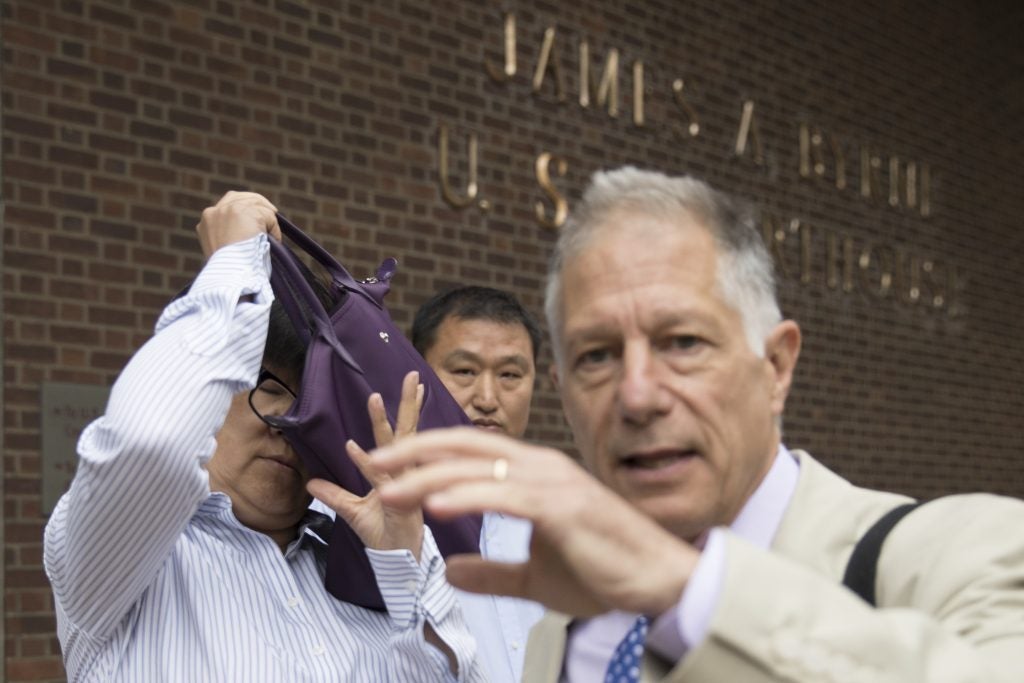
Yu Xue, left, leaving the federal courthouse in Philadelphia with attorney Peter Zeidenberg in 2018. Xue later pleaded guilty and was sentenced in the GSK trade-secret case.
Matt Rourke / Associated Press, via WHYY · Editorial use; © Associated Press / Matt Rourke
Biopharmaceutical development joins scientific data with repeatable development and manufacturing processes. The copied GSK portfolio spanned those categories. Contextual scientific illustration, not a specific stolen document.
Cancer Research UK · CC BY-SA 4.0 ↗02 / The vignette
What happened
A scientist built a second enterprise
Xue's GSK role gave her access across the drug-development pipeline: candidate products, research results, development platforms, manufacturing processes, and regulatory material. While retaining that trusted position, she co-founded Renopharma with Li and others in China, creating an undisclosed commercial destination for information she encountered at work. S1S2
Two hundred documents crossed the boundary
Xue copied approximately 200 GSK documents, some containing trade secrets, and moved them by email and portable storage to collaborators. Investigators found GSK confidential and trade-secret files on Li's computer, and some draft material had replaced references to GSK with Renopharma's name—evidence of an effort to repurpose, not merely archive, the work. S1S2
Theft was proved; commercial damage was not
Xue pleaded guilty in 2018 and received eight months in prison; Li received 59 days. Their pleas establish the conspiracy and intended benefit to Renopharma. At sentencing, however, prosecutors did not prove an intended pecuniary loss, and the courts found no realized product, sale, or profit using the information. That $0 loss finding limits the harm claim without undoing the convictions. S1S2
03 / Anatomy
How access became transfer
This chain reconstructs the sequence supported by the cited record. It does not imply that every legitimate relationship follows the same path.
- 01
- 02
- 03
- 04
- 05
- 06
Competitive harm
Theft proved; monetary loss not proved
Both defendants were convicted by plea, while the district and appellate courts rejected the government's requested intended-loss enhancement. S2
04 / Evidence boundary
What is established—and what is not
Established in the record
- Xue and Li admitted conspiring to steal GSK trade secrets for the benefit of their China-based startup. S1S2
- Xue stole approximately 200 documents spanning development products, research data, and development and manufacturing processes. S1S2
- At arrest, Renopharma had made no profit and had not developed or sold a product using GSK information; courts assigned $0 actual and intended pecuniary loss for sentencing. S2
Uncertain, limited, or unresolved
Subject response / procedural context
- At sentencing, the defendants disputed the government's valuation and presented evidence that Renopharma pursued different targets and had not used the material to develop a competing product. The district court credited the absence of proved pecuniary intent, and the Third Circuit affirmed. S2
05 / Sequence
Timeline
-
Li arrested
Agents found GSK confidential and trade-secret documents received from Xue on Li's computer. S1
-
Xue pleads guilty
Xue admitted conspiring to steal GSK trade secrets for Renopharma's economic benefit. S1
-
Sentences imposed
The district court imposed eight months for Xue and 59 days for Li after finding no proved actual or intended pecuniary loss. S2
-
Loss ruling affirmed
The Third Circuit upheld the district court's refusal to apply the intended-loss enhancement. S2
06 / People and institutions
Who appears in the public record
Yu Xue
Former GSK scientist and Renopharma co-founder
Outcome: Pleaded guilty and sentenced to eight months in prison
Tao Li
Renopharma co-founder and recipient of GSK material
Outcome: Pleaded guilty and sentenced to 59 days, or time served
Renopharma
China-based pharmaceutical startup intended to benefit from the documents
Originator / affected institution
GlaxoSmithKline
Employer and owner of the protected biopharmaceutical research and development information
07 / Consequences
Documented and attributed harm
GSK suffered no proved actual monetary loss, and prosecutors did not establish that Xue and Li purposely sought to inflict pecuniary loss for the sentencing enhancement. S2
The transfer nonetheless exposed protected research and process information across multiple products to an outside startup. S1S2
08 / Hindsight analysis
Where leadership could have seen risk
These are our analytic judgments based on the public record, not court findings. They are framed to improve controls without treating nationality as a risk factor.
Founder activity overlapped employment
A scientist could build an outside company in the same technical field while retaining access to a broad internal development portfolio.
Routine transfer paths carried research
Email and portable storage moved a large document set, showing that ordinary collaboration channels can become high-value exfiltration routes.
Value and harm were conflated
Expensive research may be valuable without proving an equal realized or intended monetary loss; leadership reporting should keep those measures distinct.
09 / Apply the lesson
Actions leaders can take
- both
Join founder disclosures to access
Require and verify disclosure of outside companies, equity, fundraising, appointments, and overlapping research, then conduct a documented conflict and least-privilege review.
- both
Control portfolio-scale exports
Detect unusual cross-project email, removable-media, print, and cloud activity while keeping monitoring proportionate, transparent, and reviewed by counsel.
- both
Use precise harm language
Report what was exposed, what was used, and what monetary harm was proved as separate fields; do not substitute development cost for court-found loss.
10 / Source record
Sources
Links point to the public record reviewed for this file. Government releases can summarize court proceedings but remain government-authored sources; the source note identifies those limits.
- S1 government release
Former GlaxoSmithKline Scientist Pleads Guilty to Stealing Trade Secrets to Benefit Chinese Pharmaceutical Company ↗
U.S. Attorney's Office for the Eastern District of Pennsylvania · Published Aug 31, 2018 · Retrieved Aug 23, 2026
Xue's plea, transfer methods, document categories, Renopharma relationship, and government subsidies.
- S2 court record
United States v. Yu Xue and Tao Li, Precedential Opinion ↗
U.S. Court of Appeals for the Third Circuit · Published Aug 2, 2022 · Retrieved Aug 23, 2026
Controlling appellate account of the pleas, approximately 200 documents, sentences, product-use record, and $0 actual and intended pecuniary loss findings.